
Falun Gong Practitioners Worldwide Mark 26th Anniversary of Historic Peaceful Appeal in Beijing

Over 10,000 Falun Gong practitioners peacefully gathered on April 25, 1999, at Fuyou Street in Beijing to appeal.
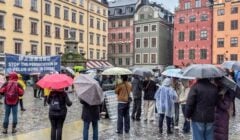
NEW YORK — April 25, 2025 marks the 26th anniversary of the historic peaceful appeal by over 10,000 Falun Gong practitioners in Beijing, an event that captured global attention for its unprecedented display of discipline, compassion, and civic integrity. Around the world, practitioners in New York, London, Toronto, Melbourne, Taipei, Sydney, Berlin, Auckland, and other cities are gathering to commemorate the day with events promoting peace, human rights, and spiritual freedom.
On April 25, 1999, Falun Gong practitioners gathered quietly outside the State Council Appeals Office near Zhongnanhai, the central government compound in Beijing. Their goal: to request the release of dozens of illegally detained practitioners in Tianjin, lift a ban on Falun Gong publications, and restore a lawful environment for spiritual practice.
Despite the large turnout, the appeal was entirely peaceful. No banners, no slogans, no conflicts—just quiet appeals for justice. Premier Zhu Rongji met with practitioner representatives and ordered the release of those detained. The crowd dispersed quietly, even collecting litter before leaving. Observers praised the event as “the most rational, peaceful, and orderly citizen petition in modern Chinese history.”
A practice grounded in peace
Falun Gong, also known as Falun Dafa, is a spiritual discipline rooted in Buddhist traditions, introduced by Mr. Li Hongzhi in China in 1992. Emphasizing the principles of Truthfulness, Compassion, and Forbearance, the practice became immensely popular across China due to its health benefits and focus on moral character.
In the 1990s, however, Falun Gong came under increasing attack from elements within the Chinese government. Despite seven years of peaceful appeals and outreach, on the evening of April 25, 1999, then-CCP leader Jiang Zemin issued a directive to “defeat” Falun Gong—a personal and political decision that triggered a nationwide campaign of persecution just months later.
Commenting on the April 25 appeal, China analyst Ethan Gutmann wrote in National Review, “A post-Communist civil society in China will include a role for Falun Gong, and we should better understand the real history of the movement… Falun Gong did not start this war. The Chinese Communist Party did. And the Party should be held fully accountable for the results.”
An ongoing human rights crisis
Since July 1999, Falun Gong practitioners in China have been subjected to arbitrary arrest, torture, forced labor, and organ harvesting. Independent investigations—including from lawyers, medical experts, and human rights organizations—have confirmed the Chinese regime’s role in these crimes against humanity.
Nonetheless, Falun Gong practitioners continue to respond with nonviolence, resilience, and compassion. “Throughout Chinese history, whenever there is a conflict between the government and the people, there were usually two outcomes. Either violent rebellion or passive submission,” said Dr. Larry Liu, deputy director of the Falun Dafa Information Center, during an April 24 webinar on dissent in China. “But Falun Gong took neither approach. Instead, they started the largest civil disobedience movement in modern Chinese history.”
Threats and disinformation
In recent years, the Chinese Communist Party (CCP) has extended its campaign of repression far beyond China’s borders, targeting Falun Gong practitioners with tactics of transnational repression that include bomb threats, shooting threats, lawfare, and sophisticated disinformation operations.
Most recently, the April 25 parade in New York City—held annually to commemorate a peaceful appeal by Falun Gong practitioners in 1999—was threatened by anonymous individuals who described a violent and detailed plan targeting participants. One threatening email claimed that “grenades and petrol bombs will be thrown at the parade and guns will be fired.” Fortunately, no violence occurred, and the event concluded safely.
Anonymous threats have also targeted Shen Yun Performing Arts—a renowned American performing arts company founded by Falun Gong practitioners. Numerous Shen Yun performances in the United States, Canada, Europe, and South America have faced violent threats, including the Kennedy Center in Washington, D.C. Investigations suggest these threats may be linked to Chinese state-backed actors seeking to intimidate audiences and damage Shen Yun’s reputation. These threats are often accompanied by disinformation campaigns against Falun Gong and its entities, spreading false narratives through state-aligned or compromised media, paid online trolls, and pressure on local officials.

These coordinated attacks, which include digital censorship, psychological warfare, lawfare, and public safety threats, have prompted warnings from national security experts and bipartisan lawmakers who see the CCP’s behavior as a direct threat to democratic societies and U.S. sovereignty.
A global movement for truth
Today, Falun Gong is practiced in over 100 countries. Its core text, Zhuan Falun, has been translated into more than 50 languages. Shen Yun Performing Arts, established by Falun Gong practitioners in the U.S., has become a global cultural phenomenon, performing nearly 8,000 shows in over 200 cities and promoting the values of Truthfulness, Compassion, and Forbearance on the world stage.
As the world enters a period of profound change, practitioners believe that the CCP’s persecution of Falun Gong has revealed the regime’s deep moral and political bankruptcy. Many see April 25 as a turning point in modern Chinese history and a model of peaceful resistance.
“As we reflect on the past 26 years, Falun Gong practitioners remain unwavering in their commitment to peace and moral integrity,” said Levi Browde, executive director of the Falun Dafa Information Center. “The values of Truthfulness, Compassion, and Forbearance are universal. They illuminate a path forward for a world in need of hope and conscience.”
For more information or interviews with Falun Gong practitioners, please contact us at [email protected].